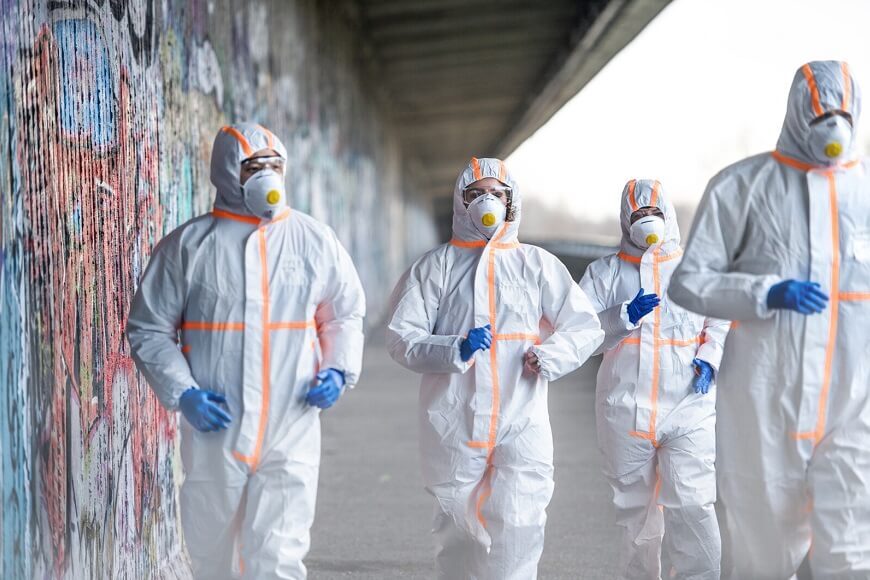
The initial economic rebound from the pandemic is likely to lull many with robust portfolio performance. The long-term implications are more sober. One outcome is likely to be a sustained search-for-yield as interest rates remain depressed worldwide. Global investors will assume uncomfortably-high risk levels in their portfolio to meet financial-return expectations, leading to distorted valuation readings across public and private markets.
In Washington, the pandemic evolved into a once-in-a-generation platform for partisan politics. Rather than center on public-health priorities, the debate over Covid-19 policies quickly became a matter of government authority versus individual liberty, with masking as a centerpiece. The Center for Disease Control, presumably a non-partisan body, may have steered off-course as it jockeyed for influence in a who-is-in-charge board game.
Beijing’s opacity at the start of the outbreak may have permanently stained its efforts at building more robust international ties. Weak cooperation on public-health issues further amplified tensions with Washington over technology and human rights. As the pandemic evolved, Chinese officials focused on vaccine diplomacy to rebuild its global stature. Yet many nations are turning away from this assistance, as Western vaccines prove more durable.
Semiconductors are an essential component in the manufacturing process. They are used heavily in automobiles and kitchen appliances, as well as medical equipment and light bulbs. While some chips are more advanced than others, global industry still has become too dependent on East Asian sources, causing production-line backups when semiconductor manufacturers shuttered because of lockdowns, among other factors.
The pandemic was a shot of adrenaline for blockchain technology. One reason is that blockchain is designed to secure and share data across borders. The rise of blockchain has meant greater acceptance of cryptocurrencies and tokenization, which in turn is fostering a fast-evolving decentralized-finance industry. Non-fungible tokens are an import offshoot of these developments. Regulatory uncertainty may be the biggest obstacle to further innovation.
In the peak days of globalization, public health issues were a distant concern. The wake-up call afforded by the SARS epidemic was insufficient. Covid-19 has killed as many as five million people, depending on data interpretation. The World Health Organization emphasizes, “The pandemic has shone a light on the intimate and delicate links between humans, animals and our environment.” Coronaviruses will linger, perhaps in perpetuity. How will we adjust?
The startup community was catapulted into the limelight by the pandemic. While there were obvious benefits to tech companies that augment the work-from-home setting, other firms sprouted with the backing of talent who abandoned the corporate workforce. In effect, the great resignation may have turbo-charged Silicon Valley, with benefits to businesses in the farm technology, space commerce, and medical technology fields, among others.
Hospitality is one of the largest industries in the world. It is also the sector most severely impacted by the pandemic. Firms in this business may be due for a much needed restructuring, given the tremendous capacity that was created in past decades. And the higher cost of travel—due to of greater input prices—may mean that skittish consumers vacation at home, rather than distant locations. The heady days of peak global movement in 2019 appear to be behind us.
While the initial economic rebound from pandemic lockdowns has been buoyant in many cases, those rates of growth are not sustainable, suggesting that economies will be dependent on fiscal stimulus for an extended period of time. A Keynesian approach to economic management was largely abandoned in the 1980s; critics argue that it squelched innovation, among other issues. We may have gone full circle in fifty years.
Read the fine print. Cranganore operates worldwide. However, the company cannot offer all services in every jurisdiction or to all businesses. We may act in concert with locally-regulated entities in some cases.
Banner Credit: Halfpoint at Can Stock Photo.